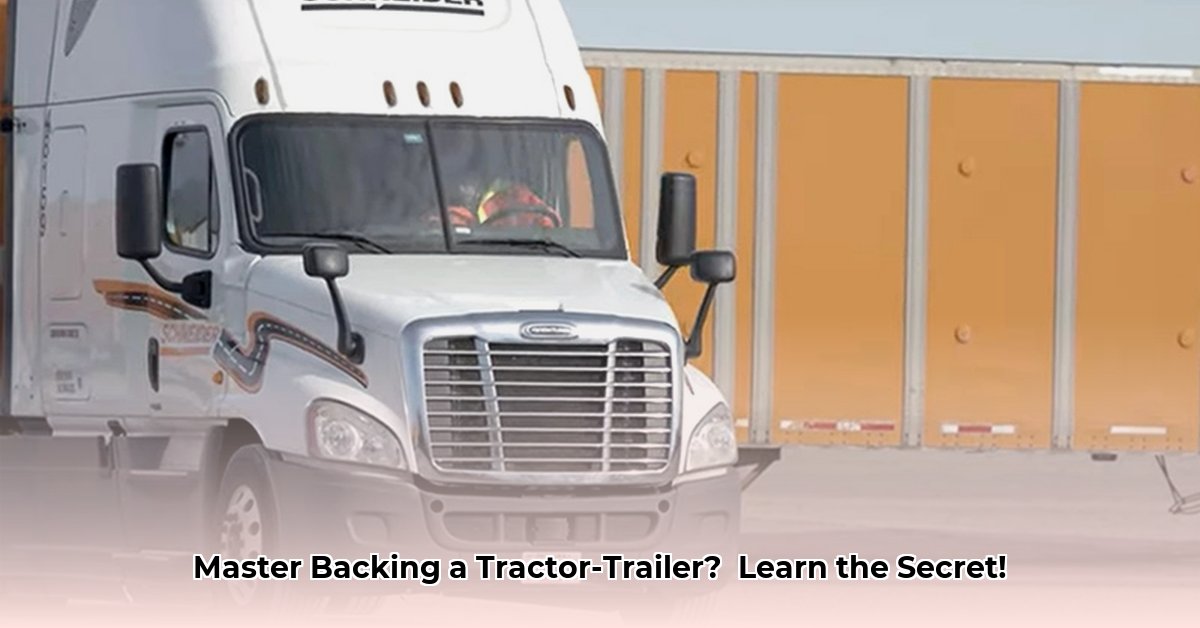
Understanding the Fundamentals of Tractor-Trailer Backing
Backing a tractor-trailer may seem daunting, but with practice and the right techniques, it becomes a manageable skill. This guide provides a step-by-step approach to mastering this crucial maneuver, emphasizing safety and efficiency. We'll cover various scenarios, from basic 90-degree backs to more complex situations, equipping you with the confidence to handle any backing challenge you face. Did you know that 90% of trucking accidents involve backing maneuvers? For more information on accident statistics, see this helpful resource: trucking accident data.
Pre-Maneuver Preparation: Planning for Success
Before you even begin, meticulous planning is key. Assess your surroundings: What's the space like? Are there obstacles—cars, poles, low-hanging branches? Mentally trace your trailer's path. Visualization significantly improves maneuverability. "Failing to plan is planning to fail," as the saying goes. This maxim is particularly true when backing a large vehicle.
The 90-Degree Backup: A Step-by-Step Guide
Let's start with the foundational 90-degree backup into a loading dock. Follow these steps:
Positioning: Begin a safe distance away, angled slightly towards your target. Accuracy isn't critical at this stage – aim for a general approach.
Mirror and Spotter Check: Utilize your mirrors. If a spotter is available, work collaboratively; clear communication is vital. Their extra eyes can prevent unseen collisions. A spotter can significantly increase safety; did you know that studies show a 40% reduction in backing accidents with a trained spotter?
Initial Steering: Gently turn your steering wheel in the direction you want the trailer to move. Remember: small corrections are more effective than large ones. Over-correction frequently leads to issues.
Observation and Adjustment: Continuously monitor your mirrors and spotter. If adjustments are needed, make small steering corrections. Minor alterations are usually sufficient.
Straightening: As your trailer aligns, gradually straighten your steering wheel. Minor adjustments may be needed to maintain alignment.
Iteration: Repeat steps 3-5 until your trailer is properly positioned.
Remember, slow and deliberate movements are paramount. Smooth, controlled actions are key to safe and efficient backing.
Advanced Backing Techniques: Mastering Complex Maneuvers
The 90-degree backup forms the basis for more intricate maneuvers. Let's explore these:
Tight Spaces and Sharp Turns: Adapting Your Approach
Tight Spaces: Expect many small steering adjustments. Patience is crucial; mastery comes with experience. A little practice goes a long way improving how you control a large rig.
Sharp Turns: You'll need a wider turn radius than initially anticipated. The trailer's swing-out will be greater than expected; plan accordingly.
Incline Backing: On inclines, take extra precautions to prevent rollbacks. Engage your parking brake and proceed cautiously.
Pro Tips for Enhanced Backing Skills
Mirror Mastery: Adjust your mirrors for optimal visibility before backing. Proper mirror adjustment is crucial for safe maneuvers.
Communication is Key: Utilize a spotter whenever feasible. Clear communication minimizes accidents. Consider hand signals for optimal communication.
Smoothness Over Speed: Slow, controlled movements are far safer and more efficient. Practice at low speeds initially.
Consistent Practice: Regular practice in a safe, open area significantly enhances your abilities. Practice builds muscle memory, improving efficiency and safety.
Troubleshooting Common Backing Issues
Jackknifing: This is usually caused by overly sharp steering. Reduce speed, breathe deeply, and correct gradually. Understanding the cause of jackknifing is critical in preventing recurrence.
Loss of Alignment: Small adjustments prevent errors. Constant mirror checks are essential.
Obstacle Collisions: Thorough pre-trip planning prevents accidents. Observe obstacles and maneuver accordingly.
Beyond the Basics: Refining Your Expertise
As you progress, explore more advanced elements:
Reference Points: Use fixed points as guides for trailer movement.
One-Hand Steering (Optional): Some drivers find this method helpful for smoother control but it requires practice and shouldn't be adopted until you are proficient in other techniques.
Trailer Dynamics: Different trailers and wheelbases affect handling. Understanding these differences increases your competence.
The "formula" for backing is not a rigid equation but a skill refined through practice and understanding vehicle dynamics. The more experienced you become, the more intuitive your maneuvers will become. Remember, safety is always paramount!